
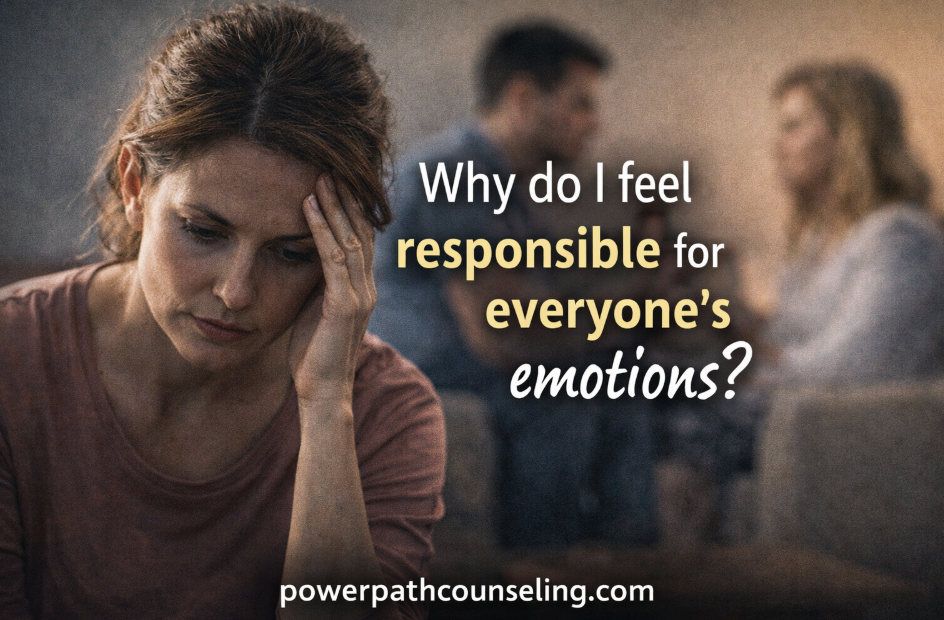
If someone is upset, do you immediately feel it in your body?
Do you start scanning for what went wrong, what you missed, or what you now need to fix?
Maybe you replay your tone.
Maybe you rush to smooth things over.
Maybe you over-explain, accommodate, or carry the emotional weight of the room before anyone even asks you to.
If that sounds familiar, you are not alone.
A lot of high-functioning, deeply caring people feel responsible for other people’s emotions.
They feel responsible for keeping the peace.
Responsible for making things okay.
Responsible for not disappointing anyone.
Responsible for making sure no one feels too hurt, too mad, too abandoned, too uncomfortable.
And over time, that can become exhausting.
Because no matter how capable, thoughtful, or loving you are, you were never meant to carry everyone else’s emotional life for them.
What emotional over-responsibility looks like
Feeling responsible for everyone’s emotions does not always look obvious.
Sometimes it looks like:
- apologizing quickly, even when you are not sure you did something wrong
- over-explaining yourself so the other person does not stay upset
- monitoring everyone’s mood before you relax
- feeling guilty when someone is disappointed with you
- stepping in to manage tension before it escalates
- making other people’s comfort more important than your truth
- feeling deeply unsettled when someone is frustrated, distant, or dysregulated
From the outside, this can look caring, mature, helpful, or highly attuned.
But inside, it often feels like pressure.
A quiet but constant pressure to keep things steady for everyone around you.
Why some people feel responsible for everyone else’s feelings
Most people do not become emotionally over-responsible by accident.
Usually, it starts as an adaptation.
Maybe you grew up in a home where tension was unpredictable.
Maybe someone’s anger filled the room.
Maybe a parent was emotionally fragile, reactive, or hard to read.
Maybe being tuned in to everyone else helped you stay safe, useful, or connected.
When that happens, the nervous system gets trained to track other people’s emotions very closely.
Not as a hobby.
As survival.
You learn to notice tone shifts.
Facial expressions.
Energy changes.
Silences.
Disappointment.
Frustration.
The first hint that something might be off.
Then you learn to respond.
Calm it down.
Fix it fast.
Make yourself smaller.
Make yourself easier.
Prevent the rupture if you can.
That strategy makes sense in context.
But later in life, it can become a burden.
Caretaking can become an identity
For many people, emotional responsibility becomes so normal that it stops feeling like a pattern and starts feeling like personality.
“I’m just empathetic.”
“I’m just the strong one.”
“I’m just the peacemaker.”
“I’m just good at reading people.”
Maybe.
And.
Sometimes what looks like empathy is actually hypervigilance.
Sometimes what looks like maturity is self-abandonment.
Sometimes what looks like being supportive is an old reflex to manage what was never yours to manage in the first place.
That is an important distinction.
Because true care does not require you to disappear from yourself.
Codependency often lives here
This is one of the places codependency often shows up.
Not only in obvious rescuing.
But in the quieter belief that other people’s emotional state is somehow your job.
If they are upset, you should fix it.
If they are disappointed, you should absorb it.
If they are dysregulated, you should regulate yourself around them and carry the extra weight.
This can create a deeply uneven dynamic.
You become the emotional manager.
The one who adjusts first.
The one who notices first.
The one who repairs first.
The one who feels guilty first.
And after a while, that does something to a person.
It breeds resentment.
Confusion.
Exhaustion.
And often a painful loss of connection with your own needs.
Family roles can train this early
Many people who feel responsible for everyone’s emotions held specific roles in childhood.
The peacekeeper.
The helper.
The good one.
The fixer.
The emotionally mature one.
The one who could not afford to make things harder.
These roles often came with a hidden message:
Other people’s feelings matter more than your internal reality.
So instead of asking, “What do I feel?”
You learned to ask, “What does everyone else need from me right now?”
That question can follow people well into adulthood.
Into dating.
Marriage.
Friendships.
Family relationships.
Business.
Parenthood.
And because the pattern is often praised, it can be hard to question.
Why boundaries can feel so guilty
One of the hardest parts of emotional over-responsibility is that boundaries can feel wrong even when they are healthy.
You may know intellectually that you are allowed to say no.
Allowed to disappoint people.
Allowed to let others have their feelings without rushing to manage them.
But in your body, it may still feel dangerous.
Why?
Because boundaries interrupt the old survival role.
If your system learned that staying connected required keeping others comfortable, then letting someone feel disappointed may register as a threat.
Not because you are selfish.
Because your nervous system is used to equating discomfort with danger.
This is why guilt shows up so fast.
Not always because you are doing something wrong.
Sometimes because you are doing something new.
Feeling responsible is not the same as being responsible
This may be one of the most important distinctions in the whole conversation.
You can feel responsible for someone’s emotions without actually being responsible for them.
Their disappointment is real.
Their anger may be real.
Their grief, frustration, or reaction may all be real.
That does not automatically make it yours to carry.
You are responsible for your choices.
Your honesty.
Your impact.
Your boundaries.
Your repair when repair is needed.
You are not responsible for controlling every emotional response another person has to your truth.
That difference can be hard to live.
But it is part of becoming more emotionally free.
The cost of carrying what is not yours
When people spend years feeling responsible for everyone else’s emotions, the cost adds up.
They become tired in ways that rest alone does not fix.
They lose clarity about what they actually want.
They start feeling trapped between resentment and guilt.
They confuse self-betrayal with kindness.
They may attract relationships where emotional labor is chronically uneven.
And underneath all of it is often a quiet longing:
I want to care without carrying everything.
I want to be kind without abandoning myself.
I want to stop feeling like everyone else’s stability depends on me.
That longing makes sense.
How to stop feeling responsible for everyone’s emotions
You do not undo this pattern by becoming cold, indifferent, or cut off.
You undo it by learning the difference between compassion and over-responsibility.
1. Notice when you go into emotional management
Pay attention to the moment you start fixing, softening, over-explaining, or monitoring.
What are you afraid will happen if you stop?
2. Separate empathy from ownership
You can care about someone’s feelings without making them your job.
That is a major shift.
3. Let discomfort exist for a moment
Someone being upset does not always mean you have done something wrong.
Sometimes it means they are having a human reaction.
And they get to have one.
4. Practice smaller boundaries
You do not have to become radically different overnight.
Start with smaller moments of self-honoring:
pausing before apologizing,
not rushing to fix,
saying, “I hear that,” instead of immediately taking everything on.
5. Rebuild trust with your own inner experience
The more you believe your own needs, limits, and truth matter, the less automatically you will hand yourself over to someone else’s emotional state.
That is how this pattern begins to change.
What healthier care actually looks like
Healthy care is not emotional absorption.
It is not carrying all the weight so nobody else has to feel uncomfortable.
Healthy care sounds more like this:
I can care about you without collapsing into your experience.
I can listen without overfunctioning.
I can be accountable without taking on what is not mine.
I can let you have your feelings and still stay connected to myself.
That kind of care is more honest.
More sustainable.
And much more compatible with real intimacy.
A final word
If you feel responsible for everyone’s emotions, it does not mean you are weak, needy, or “too much.”
It may mean you learned early that your safety, belonging, or value depended on how well you could read, manage, and accommodate other people’s emotional states.
But that pattern can change.
You can learn to care without carrying.
To set boundaries without collapsing into guilt.
To stay connected without making yourself responsible for what belongs to someone else.
That is not selfish.
That is a healthier form of love.
If this feels familiar, therapy can help you understand the pattern and begin changing it in real time. Learn more about working with Vanessa at powerpathcounseling.com.
About the Author
Vanessa Zakeya Bryant is a Texas-based therapist and founder of Power Path Counseling. She helps high-functioning individuals and couples recognize painful relational patterns, rebuild self-trust, and create more honest, connected ways of relating. Her work supports people in seeing the pattern, staying present, and choosing differently in real time. Learn more at powerpathcounseling.com.